All Guides/food
food · 4 min read
How to Spot a Tourist-Trap Restaurant in Rome
Photo menus, a man inviting you in, carbonara with cream. The tells that separate a tourist trap from a real Roman trattoria — and what the coperto is.
By Todo Rome · Updated 2026-09-21
The Problem Is Geographic
Rome does not have a tourist-trap problem so much as it has a rent problem. A restaurant with tables facing the Pantheon is paying for that view, and the bill pays the rent. It does not need you to come back, because there is an inexhaustible supply of people who will never be in Rome again.
Move five minutes away from any monument and the economics invert completely. The same street with no view has to feed the same people every week for twenty years, which is a different business entirely and produces different food.
That single fact — walk five minutes from the monument — solves most of the problem before you read another word. What follows is for the rest.
The Tells, In Order of Reliability
A photo menu. Pictures of the dishes, displayed outside. This is close to a perfect signal. Photographs exist to sell food to people who cannot read the menu and do not know the dish, which tells you exactly who the restaurant is for. A menu translated into six or seven languages is the same signal.
Someone standing outside inviting you in. The buttadentro — literally "thrower-inner". A restaurant Romans want to eat at has a queue, not a greeter. If someone is working the pavement to fill tables at 8pm in a city of three million people who eat out constantly, ask why the tables are empty.
A "menù turistico" board. A fixed price for three courses, displayed prominently, usually with a drink included. Nothing about this is illegal or dangerous. It is simply not what anyone local eats.
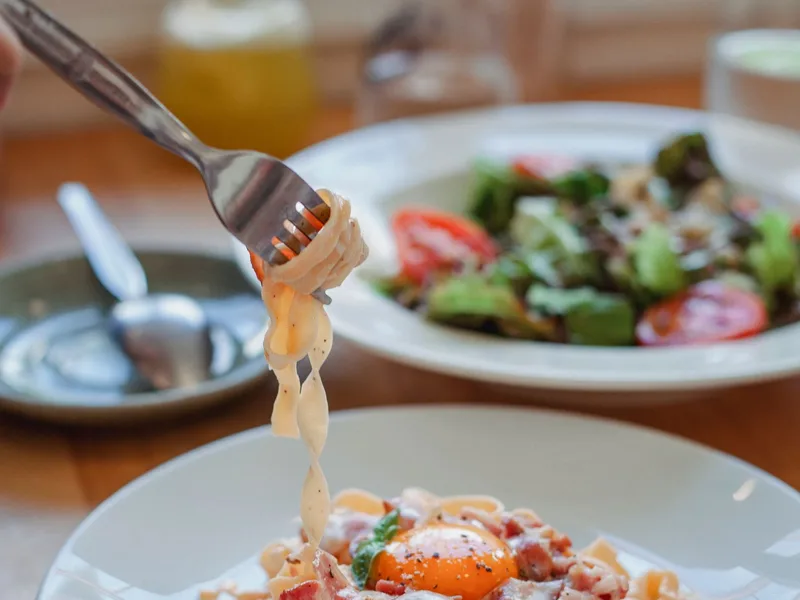
Non-Roman dishes on a Roman menu. Fettuccine Alfredo is not Italian food as Italians eat it. Spaghetti bolognese does not exist in Rome — the dish is tagliatelle al ragù, and it's from Bologna. Carbonara made with cream is the clearest single red flag on any menu in this city: real carbonara is egg, pecorino, guanciale, pepper, and nothing else.
Open all afternoon. Roman kitchens close between lunch and dinner, roughly 3pm to 7pm. A restaurant serving hot food continuously from noon to midnight is optimised for foot traffic, not for cooking.
An enormous menu. Forty dishes across every region of Italy means a freezer and a microwave. A short menu, sometimes handwritten, sometimes changing daily, means someone is actually cooking.
What a Good One Looks Like
The inverse tells are just as consistent:
- A short menu, in Italian first, with maybe an English translation underneath rather than a separate laminated tourist version.
- A weekly closing day. Almost every genuine Roman restaurant closes one day a week, often Monday. A place that never closes is a machine, not a kitchen.
- Roman dishes done properly — cacio e pepe, amatriciana, carbonara, coda alla vaccinara, carciofi in season. Which brings up the best test of all:
- Seasonality. Ask for carciofi alla giudia in August. Roman artichokes run roughly February to April. A restaurant that serves them year-round is serving you something that arrived frozen.
- Italians eating there, at Italian hours — 1.30pm for lunch, 9pm for dinner. A dining room full at 6.30pm is a dining room full of tourists.
See our restaurants guide for specific places that pass all of this, including Trattoria da Enzo al 29 in Trastevere, and the pizza guide for the equivalent by the slice.
The Coperto Is Not a Scam
This causes more bad reviews from visitors than anything else on the bill, and it's a misunderstanding.
The coperto is a per-person cover charge, typically €1.50 to €3, covering bread, linen and the table setting. It is normal, it is legal, it must be stated on the menu, and every kind of restaurant charges it — the trattoria the locals love charges it too. It is not a tip and not a scam.
What you should look at instead:
- Servizio. A service charge of 10–15% added on top is far less common in Rome and must be disclosed. If you see both a high coperto and a servizio, you're in a tourist restaurant.
- "Pesce fresco" at market price. Fish sold by weight with no price shown is where genuinely large bills come from. Ask what it costs before agreeing.
- The seated coffee rule. Standing at the bar, an espresso is around €1.20. Sitting at a table, it can be €4.50 or more. This is posted, legal and universal — not a rip-off, just a convention that surprises people. Our costs guide has the rest of the pricing conventions.
Tipping, for the record, is not expected in the way it is in the US. Rounding up, or leaving a couple of euros for a good meal, is plenty.
The Short Version
Walk five minutes off the square. Skip anywhere with photographs of the food or a man outside. Read the menu for cream in the carbonara and artichokes out of season. Eat at 1.30 or at 9. Expect a coperto and don't be annoyed by it.
That's the whole method, and it works in every neighbourhood in this city — including, with a little more walking, the ones with the monuments in them.