All Guides/culture
culture · 10 min read
Rome Colosseum: The Complete Guide
Everything you need to know about visiting the Colosseum — which ticket to buy, arena floor and underground access, when to go, and the mistakes that cost people their morning.
By Todo Rome · Updated 2026-09-09
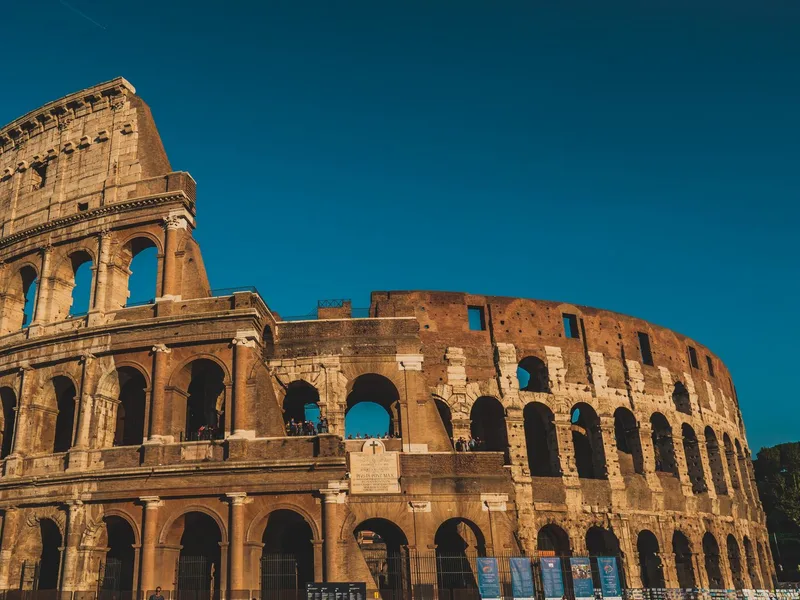
Two Thousand Years, One Amphitheatre
The Colosseum opened in 80 AD with a hundred days of games and has been the single most recognisable building in Rome ever since. Eighty arched entrances, seating for around 50,000 spectators sorted strictly by social class, and an engineering system — the velarium, a retractable canvas awning worked by sailors seconded from the imperial fleet, and the hypogeum, a two-level network of tunnels and lifts beneath the arena floor — that wouldn't look out of place in a modern stadium.
Most visitors spend forty minutes walking the perimeter, take photographs from the Piazza del Colosseo, and move on. Given what's underneath and next door, this is a mistake.
Why It Is Where It Is
The site was chosen as a political statement. Nero had seized a vast tract of central Rome after the fire of 64 AD and built the Domus Aurea, his golden palace, with an artificial lake at its centre. When the Flavian dynasty took power after Nero's fall, Vespasian drained that lake and put a public amphitheatre on it — handing the emperor's private pleasure ground back to the people of Rome. It is one of the most pointed pieces of urban politics ever built.
Its real name is the Flavian Amphitheatre. "Colosseum" comes from the Colossus of Nero, a thirty-metre bronze statue that stood beside it and outlasted the building's original name.
Construction began around 72 AD under Vespasian and finished under his son Titus. Gladiatorial combat was banned in the early fifth century; animal hunts limped on until around 523. After that the building became, in turn, a quarry, a fortress for the Frangipane family, and a church. The asymmetry you see today — the outer wall standing at full height on one side and sheared away on the other — is largely the work of the earthquake of 1349, and the pockmarks across the travertine are the sockets of iron clamps prised out for reuse in the Middle Ages.
Which Ticket You Actually Need
This is where people go wrong, and it is worth being precise, because the naming is genuinely confusing.
| Ticket | Roughly | Covers |
|---|---|---|
| Full Experience | €18 | Colosseum + Roman Forum + Palatine Hill. 24 hours from first entry |
| Arena Floor | €24 | The above, plus standing on the reconstructed arena floor |
| Full Experience Underground | €24+ | The above, plus the hypogeum — guided, small groups only |
The critical point: the standard Full Experience ticket does not include the arena floor or the underground. Those are separate, pricier products with far fewer daily slots. A great many visitors book the standard ticket assuming it covers everything, and only discover otherwise at the turnstile.
Book in advance, always. Official tickets are released 30 days ahead, and the Underground and Arena slots sell out first — particularly weekend mornings. Walk-up availability is unreliable from May to September and effectively non-existent for the underground.
Buy from the official channel. In 2025 Italy's competition authority fined the companies that had handled Colosseum ticketing tens of millions of euros over practices that pushed visitors into more expensive bundled products. Resellers still work the same ground. Anyone approaching you outside the site with a queue-skipping offer is selling you something you could have bought yourself for less — see our safety and scams guide for how that pitch runs.
When to Go
First slot of the day (08:30) is the best. The site is emptiest, the temperature is survivable in summer, and the low light on the travertine is far better for photographs than the flat glare of midday.
The last two hours before closing are the second-best window, and often the more atmospheric one — the crowds have thinned and the stone goes gold.
Avoid 11am to 3pm if you have any choice. That is when the coach groups and the cruise excursions arrive, and when the arena is at its most airless.
Season matters as much as time of day. November to February the site is genuinely quiet. April, May, September and October are pleasant and busy. July and August are hot, crowded, and largely shadeless — if that's when you're here, take the 08:30 slot and treat it as non-negotiable.
The Arena Floor
Standing where gladiators stood is the single best reason to pay extra. A partial wooden floor has been reconstructed over one section of the hypogeum, giving you the view spectators never had: straight down into the machinery of the games rather than up at it.
Combine it with the underground ticket if you can. Seeing the lift shafts and holding pens from below, then standing on the floor above them, is what makes the whole building click into place — you stop looking at a ruin and start seeing a machine.
The Hypogeum (Underground)
Two levels of brick corridors, holding cells, and the remains of the capstan-powered lift system — some two dozen lifts, hauled by teams of slaves, that raised scenery, animals and fighters up through trapdoors into the arena.
Guided small-group tours only; you cannot visit independently, and they book out weeks ahead in summer. This is, without much competition, the most interesting forty-five minutes in the entire complex. If you only pay extra for one thing in Rome, make it this.
What to Look For Inside
Most people photograph the arena and leave. A few details repay slowing down for.
The numbers above the arches. Roman numerals are still legible over many of the ground-level entrances. Spectators were issued tesserae — pottery tokens stamped with a gate, tier and row — and the numbering let fifty thousand people fill and empty the building in minutes. It is the same principle as a modern stadium ticket, and it worked.
The three orders of columns. Doric at the bottom, Ionic in the middle, Corinthian on top, getting lighter and more ornamental as they rise. This is the textbook example every architecture student is shown, and it is more legible in person than in any photograph.
The seating hierarchy. Senators sat at the arena's edge on marble, then equestrians, then ordinary citizens in stone tiers above. Women and the enslaved were placed highest and furthest away, in wooden seating that has not survived. Where you stand in the building tells you exactly what you would have been worth to the Roman state.
The cross. A modest cross stands inside, marking the amphitheatre as a site of Christian martyrdom. The historical evidence that Christians specifically died here is thinner than the tradition suggests, but the Good Friday Stations of the Cross procession still takes place at the Colosseum each year, led by the Pope.
Roman Forum & Palatine Hill
Your Colosseum ticket includes both at no extra charge, and skipping them is the second most common mistake visitors make.
The Forum was the political and commercial centre of the ancient world — the Curia where the Senate met, the Rostra where Mark Antony gave the funeral oration, the Temple of Saturn's surviving columns, the Arch of Titus. It reads as a confusing field of rubble unless you have some idea what you're looking at, so this is the one place a guide or a decent audio guide genuinely earns its fee.
The Palatine Hill above it is where the emperors actually lived, and it is the better half: fewer people, more shade, and the view down over the Forum on one side and the Circus Maximus on the other.
Budget ninety minutes minimum for the pair. The entrance is on Via Sacra and Via di San Gregorio, separate from the Colosseum's own turnstiles — five minutes' walk, and generally far less crowded.
Guided Tour, or On Your Own?
Go guided if you want the underground (there is no other way in), or if you want the Forum to make sense. The Forum in particular rewards a guide more than almost any site in Rome, because so little of it is self-explanatory.
Go independent if you have read a bit beforehand, or you would rather move at your own pace. The Colosseum itself is fairly legible on its own — it is a stadium, and it looks like one.
A middle path that works well: book the Underground tour, which is guided by necessity, and then walk the Forum and Palatine independently afterwards with your ticket, taking as long as you like.
Getting There & Practical Notes
Metro: Colosseo on Line B puts you out directly at the north side.
Security: airport-style scanners at every entrance. Arrive twenty minutes before your slot, not on the dot.
Bags: no large backpacks or suitcases. There is a small bag-check but it is slow — travel light and skip the problem.
Water: nasoni drinking fountains run cold and free around the site. Bring a refillable bottle rather than buying from the vendors outside.
Shade: there is essentially none, across all three sites. A hat in summer is not optional.
Shoes: the Forum and Palatine are uneven ancient paving and gravel. This is not the day for new sandals.
Visiting With Children
The Colosseum is one of the easier major sites to do with kids, because the story tells itself — it was a stadium where dangerous things happened, which needs no explaining to an eight-year-old.
Practical notes: the arena floor ticket is the one children respond to most, since standing in it beats looking at it. The Forum is where attention usually fails, so do the Colosseum first while everyone is fresh. Pushchairs are awkward on Forum gravel and Palatine slopes; a carrier is easier for small children. Under-18s generally enter free at state sites, though you still need to reserve a ticket for them.
Accessibility
The Colosseum has lifts to the first and second tiers and is broadly navigable by wheelchair, with step-free routes marked and staff used to assisting. The Forum and Palatine are considerably harder — original paving, gravel, and real gradients on the hill — though there is an accessible route via the Via di San Gregorio entrance. The hypogeum is not wheelchair accessible.
Visitors with disabilities and one companion each enter free at state sites, which includes all three here.
Five Mistakes to Avoid
- Assuming Full Experience includes the arena floor. It doesn't. Check what you bought before you travel, not at the gate.
- Skipping the Forum and Palatine. They are already paid for on your ticket.
- Booking a midday slot in July. No shade, peak crowds, worst light.
- Buying from a tout outside. Overpriced at best; official channels only.
- Turning up with a large backpack. The bag-check queue can cost you your entry window.
After the Colosseum
Monti, immediately behind the Forum, is a seven-minute walk and the sensible place to eat — the streets right around the Colosseum are priced for people who don't know there's an alternative. See our Monti guide.
Testaccio, twenty-five minutes on foot or a short metro hop, is the neighbourhood that invented most of the dishes on a modern Roman menu — see the restaurants guide for where to eat there.
The Aventine keyhole, a fifteen-minute uphill walk from the Circus Maximus (itself two minutes from the Colosseum), frames St Peter's dome perfectly at the end of a hedged avenue. Quiet, free, and one of Rome's best five minutes.
The Capitoline terrace, ten minutes north-west, gives you the best free view back over the Forum with the Colosseum framed at the end of it. Come here at sunset on the same day and you will have seen the site from the inside and from above.