All Guides/culture
culture · 6 min read
Trevi Fountain: Tickets, the €2 Fee & When to Go
Rome now charges €2 to enter the Trevi Fountain basin. Who pays, who doesn't, the free night window, and how to see it without the crush.
By Todo Rome · Updated 2026-09-09
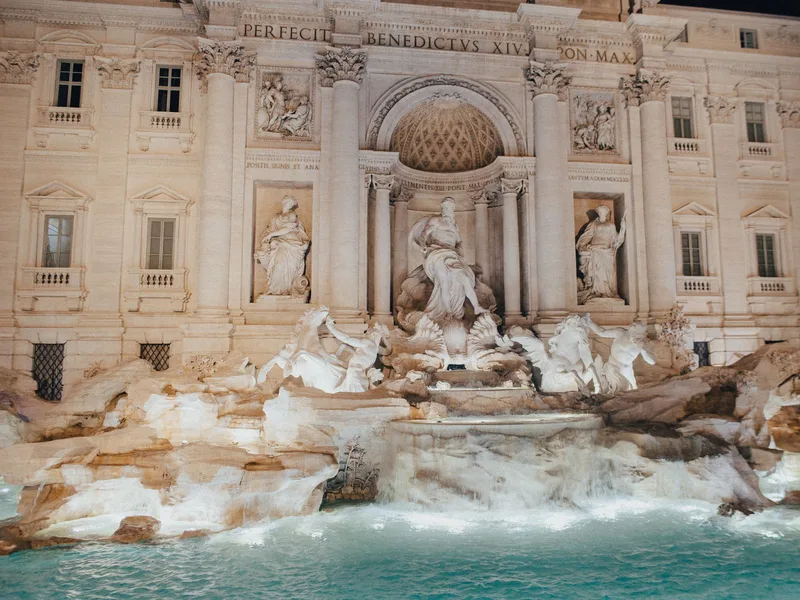
What Changed, and When
Since 2 February 2026, entering the lower basin of the Trevi Fountain — the sunken area closest to the marble, where almost every photograph of the fountain is taken — costs €2 for non-residents.
This is new, and it catches people out. Most travel guides, guidebooks printed before 2026, and a good deal of what you'll find online still describe the Trevi as free to visit. That was true for its entire prior history. It isn't any more, and if you turn up expecting to walk straight down to the water you'll meet a gate and a queue instead.
What has not changed is just as important: the piazza itself remains free. You can stand at the upper level, see the whole fountain, take photographs, and leave without paying anything. The €2 buys you the last few metres.
Who Pays and Who Doesn't
The charge applies to tourists and non-residents. Free access continues for:
- Residents of Rome
- Children up to five years old
- Visitors with disabilities, and one accompanying carer each
Everybody else pays €2 per person during charging hours. There is no reduced rate for students, seniors, or large groups — it is a flat fee, which at least makes the arithmetic simple when you're travelling as a family.
The Free Window: 10pm to 9am
Here is the part that matters most, and that almost nothing else has picked up on yet.
The fee applies only between 9am and 10pm. Outside those hours — from 10pm through to 9am the following morning — the basin is open and free.
This is genuinely useful rather than a technicality, because night is when you should be visiting the Trevi anyway. The fountain is lit after dark, the marble reads white against the black of the palazzo behind it, and the crowd thins from a crush to something you can move through. At 11pm on a weekday in October you can stand at the water with maybe thirty other people. At 2pm on a Saturday in June you cannot see the water at all.
Early morning works on the same principle and is even quieter. Arrive before 9am — say 7:30 — and you will share the basin with a handful of photographers and someone sweeping up yesterday's coins.
If your schedule is fixed and you can only come at midday, pay the €2 without agonising over it. But if you have any flexibility at all, the free window is also the better experience, which is a rare thing in Rome.
How the Ticketing Works
The system is deliberately light-touch, and there are a couple of things worth knowing:
It is not a timed ticket. You are not booking a slot for 14:30 on a particular Tuesday. It is a straightforward admission to the basin.
It is not date-specific. This follows from the above — the ticket is an entry fee, not a reservation tied to one day.
You can usually just turn up and pay. In practice the queue moves quickly because the transaction is trivial. Some third-party operators sell pre-booked entry if you want a guaranteed time and no wait at all, but for a €2 admission most people will find that more friction than it saves.
The practical consequence: don't spend an evening trying to book Trevi Fountain tickets in advance the way you would for the Colosseum. It is a different kind of thing entirely.
The Coin Toss, Properly Done
The ritual survives the ticketing, and it is the reason a lot of people come.
The form is: right hand, over your left shoulder, with your back to the fountain. One coin buys you a return to Rome. The elaborations you'll hear — a second coin for romance, a third for marriage — are a twentieth-century embellishment, popularised largely by the 1954 film Three Coins in the Fountain. Nobody in Rome takes the second and third coins seriously, but nobody will stop you either.
Roughly €1.5 million a year lands in the water. It is collected regularly and goes to Caritas, the Catholic charity, which uses it for food programmes and social services across the city. Fishing coins out is theft and is prosecuted as such — people have been arrested for it.
You can toss a coin from the upper level for free. It's a longer throw and it feels less ceremonial, but the euro still lands in the same water.
Watch Your Pockets
The Trevi basin is one of the most reliable pickpocket sites in Rome, and it is worth being blunt about why: it produces a crowd of distracted people, packed shoulder to shoulder, all facing the same direction with their phones raised and their attention entirely on the fountain. That is close to a perfect working environment.
The gating has thinned the crowd somewhat, but it hasn't eliminated the problem, and the queue outside the gate is now its own target.
What actually works is unglamorous: a zipped bag worn across your body at the front, phone in a front pocket or in your hand rather than a back pocket, and no wallet anywhere reachable from behind. That defeats the overwhelming majority of attempts, because the method depends on getting into a pocket you aren't looking at.
Also, decline the friendship bracelets. Somebody will approach with a woven bracelet, tie it to your wrist before you've agreed to anything, and then demand payment loudly enough to be uncomfortable. The same script runs with roses. The answer is to keep your hands down, say no clearly, and keep walking — engaging at all is what the approach is designed to achieve.
What's Within Ten Minutes
The Trevi is small, and you should not build half a day around it. Twenty minutes at the fountain is plenty. Everything below is a short walk:
- The Pantheon — eight minutes west. Note that it also charges now (€5 since 2023), which surprises people even more often than the Trevi fee does.
- The Spanish Steps and Piazza di Spagna — ten minutes north, free, and best in the early evening.
- Piazza Navona — twelve minutes west, past the Pantheon, and free.
- The Quirinale — five minutes uphill, with one of the better views back over the rooftops and almost no tourists.
A sensible evening: eat somewhere in the centro, walk to the Trevi at about 10:30pm when the fee lifts and the crowd has gone home, then carry on to the Pantheon, which is floodlit and nearly empty at that hour. That sequence costs nothing and is the best version of central Rome on offer.
Is It Worth €2?
Honestly: the fee is not the issue. Two euros is less than a coffee sitting down, and the money goes toward maintaining a fountain that thirty million people a year climb over.
The real question is whether the daytime visit is worth it, and mostly it isn't — not because of the price, but because at midday you are looking at the backs of other people's heads. The fountain is a piece of theatrical Baroque engineering, thirty metres of it, designed to be seen whole. You need room to stand back, and at 2pm in high season there is no room.
So: pay the €2 if daytime is when you're there. But if you can shift your visit into the free window, you'll get a better fountain and keep the money.