All Guides/culture
culture · 9 min read
Vatican Museums & Sistine Chapel Guide
How to see Michelangelo's ceiling without losing half a day to queues — which ticket, when to book, the route through the museums, and what to skip.
By Todo Rome · Updated 2026-09-09
The Single Most Important Reason to Come to Rome
Thirteen metres by forty, painted over four years by one man, and still the reason more people fly to Rome than for any other single work of art on earth. The Sistine Chapel ceiling is the final room of the Vatican Museums' one-way route — which means that to see it, you first walk through one of the largest museum complexes ever built.
One correction worth making before you go, because you will hear it from a guide within the hour: Michelangelo did not paint the ceiling lying on his back. He designed his own scaffolding and painted standing, head bent backwards, which he described in a bitterly funny poem about his beard pointing at heaven and paint dripping into his face. It is a small thing, but the popular image gets the physical reality of the achievement exactly wrong.
Book Ahead — How Far
This is the one Rome site where booking is not optional.
Peak season (April–June, September–October): book three to six weeks ahead for a specific morning slot. Early Entrance tours go faster than that.
July and August: book earlier still. This is the busiest and least comfortable time, and the queue without a reservation regularly passes two hours in full sun.
November–February: same-week booking is usually fine, and the museums are genuinely pleasant.
Entry is around €20 plus a roughly €5 online reservation fee. That fee is not optional in any meaningful sense — it is the price of not losing a morning, and everyone who skips it regrets it.
Which Ticket
Standard entry gets you in at your booked time slot. The baseline, the cheapest official option, and perfectly adequate if you arrive early.
Early Entrance (07:30 or 08:00, before general opening) puts you in the Sistine Chapel roughly ninety minutes before the crowds. This is the single best upgrade available at any Rome site. The difference between the chapel at 08:15 and the chapel at 11:30 is the difference between contemplation and a rush-hour platform.
Guided tours move faster through the connecting galleries and explain what you're looking at, which matters more here than in almost any other museum. The Raphael Rooms and the Gallery of Maps in particular reward context you will not get from a wall label. Guided groups are also the only ones who use the connecting passage to St Peter's — see below.
Whatever you book, avoid Wednesday mornings, when the papal audience fills St Peter's Square and the overflow works through the whole Vatican, and the last Sunday of the month, which is free and consequently the most crowded day on the calendar.
The Route: What to Actually Look At
The route is one-way and long — two to three hours minimum, and considerably more if you stop properly. The museums hold something in the order of seventy thousand objects; trying to see them all before the Sistine Chapel means arriving at the ceiling too tired to look up.
Pick your stops deliberately. These are the ones worth the time:
The Pio-Clementino. Classical sculpture, and specifically the Laocoön — unearthed in a Roman vineyard in 1506 with Michelangelo himself present at the dig, and immediately one of the most influential objects in European art. The straining, twisting bodies he saw that day run straight into the Sistine ceiling two years later. The Belvedere Torso nearby did the same job.
The Gallery of Maps. A hundred and twenty metres of sixteenth-century topographical frescoes of the Italian peninsula, under a gilded barrel vault, painted between 1580 and 1585. Visitors routinely march down it looking at their phones. It is one of the most beautiful rooms in Rome — slow down.
The Raphael Rooms. Four rooms painted for Pope Julius II by Raphael and his workshop, including The School of Athens, which is arguably the best fresco in the building not named the Sistine Chapel. They sit one room before the main event and are consistently less crowded, because everyone is hurrying past them.
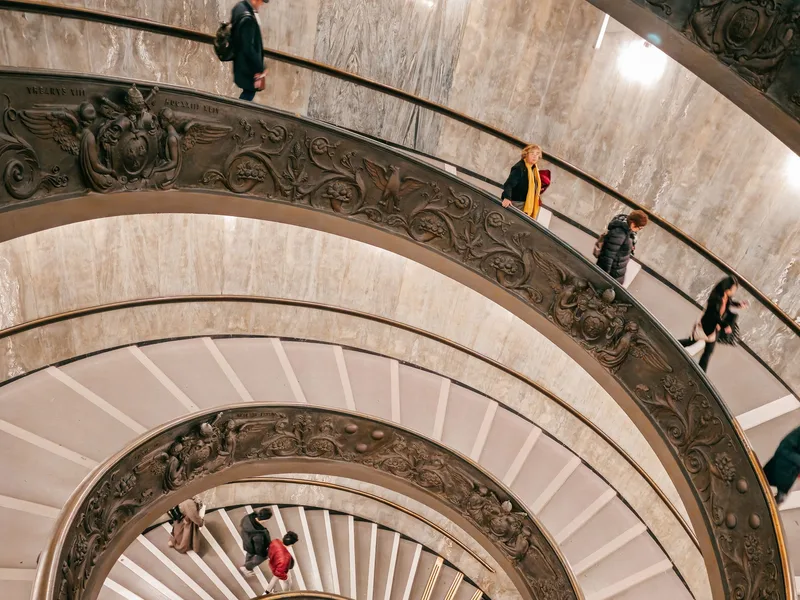
The spiral staircase. Giuseppe Momo's 1932 double-helix ramp near the exit — two intertwined spirals so that people going up never meet people coming down. It is the most photographed thing in the museums after the chapel itself, and it is at the end, so you don't have to plan for it.
The Sistine Chapel, Properly
Two separate commissions, thirty years apart, by the same man.
The ceiling (1508–1512) runs nine scenes from Genesis down the spine, from the separation of light and darkness to the drunkenness of Noah, framed by prophets and sibyls. The Creation of Adam is the famous panel, and it is smaller and higher than people expect. Note the order: the scenes run from the altar end, so if you read them from the entrance you are going backwards through Genesis.
The Last Judgment (1536–1541) covers the altar wall, painted when Michelangelo was in his sixties, and it is a different and much darker artist — a churning wall of bodies rising and falling with no framing architecture at all. Find St Bartholomew, holding his own flayed skin: the face on the skin is Michelangelo's self-portrait, which tells you something about how he felt by then.
The rules are enforced. No photography of any kind, and no talking above a murmur — guards say both loudly and often, which is itself part of the experience. This is a consecrated chapel and the room where papal conclaves are held, not a gallery.
Strategy: find a spot along a side wall, sit on the bench if there is space, and stay for twenty minutes. Most people give it four. The neck strain is real and so is the payoff.
Getting to St Peter's Afterwards
There is a connecting passage from the Sistine Chapel directly into St Peter's Basilica, and it saves a genuine forty minutes. It is reserved for guided groups, and independent visitors are generally turned back — this is worth knowing before you plan around it, because a lot of advice online implies anyone can use it.
If you are on a guided tour, you will likely go through it. If you are visiting independently, expect to exit the museums, walk around the Vatican walls to St Peter's Square, and queue again at the basilica's own security check — usually twenty to forty minutes, considerably faster than the museum queue, and free.
St Peter's Basilica
Free, and the most impressive interior in Rome. Allow an hour.
Michelangelo's Pietà is immediately on the right as you enter, behind glass since it was attacked with a hammer in 1972. He carved it at twenty-four, and it is the only work he ever signed — across the band on the Madonna's chest, reportedly after overhearing someone credit it to another sculptor.
Bernini's baldacchino stands over the papal altar: twenty metres of twisted bronze columns, much of it taken, according to Roman tradition, from the Pantheon's portico. This is the source of the line quod non fecerunt barbari, fecerunt Barberini — what the barbarians did not do, the Barberini did.
The scale is the thing that doesn't photograph. Look at the cherubs holding the holy water stoups near the entrance: they appear normal-sized until you stand beside one and find it is taller than you are. The floor is marked with the lengths of other major cathedrals, all of which stop short.
The Dome Climb
551 steps in total, with a lift available for the first stretch to roof level, leaving around 320 on foot. Paid, separate from basilica entry, and worth doing on a clear day.
Two things to know. The final section runs between the inner and outer shells of the dome, so the wall leans in with you as you climb — genuinely disorienting if you are claustrophobic, and there is no way back down once you commit to that stretch. And the interior gallery on the way up puts you directly under the dome looking down into the basilica, which is worth the ticket on its own.
The view from the top is the best in Rome: straight down the axis of St Peter's Square, out over the whole city.
Dress Code & Practical Notes
Dress code, strictly enforced at both the museums and the basilica: shoulders and knees covered, for everyone. People are turned away every day in summer. Carry a light scarf if you're unsure — it solves the problem in five seconds.
Metro: Ottaviano–San Pietro on Line A, then about ten minutes on foot.
Bags: large backpacks must be checked. Allow time.
Food: skip the museum café. Walk into Prati, where Pizzarium Bonci and Gelateria Old Bridge are both within ten minutes of the walls and vastly better value — see our pizza guide.
Time budget: three hours for the museums, one for the basilica, one more if you climb the dome. This is a half-day at minimum and a full day if you do all of it properly.
With Children, and On Wheels
The Vatican Museums are hard work for young children — long, crowded, one-way, and with no easy exit once you are committed to the route. If you're going with kids, take the earliest slot you can, head for the Sistine Chapel with only a couple of stops, and treat the rest as optional. Under-18s pay a reduced rate.
For accessibility, the museums are largely step-free with lifts on the main route, and wheelchairs can be borrowed free at the entrance. St Peter's is accessible at ground level. The dome climb is not accessible, and the spiral staircase has a step-free alternative route.
Four Mistakes to Avoid
- Turning up without a booking. In summer this costs you two hours in direct sun.
- Planning to use the Sistine shortcut as an independent visitor. It's for guided groups.
- Coming on the last Sunday of the month. Free entry, and the worst crowds of the month.
- Trying to see everything. The route is enormous. Pick three stops and give them real time.
One More Stop, If You Have the Legs
From St Peter's Square, Castel Sant'Angelo is a straight ten-minute walk down Via della Conciliazione — Hadrian's mausoleum turned papal fortress, connected to the Vatican by the passetto, the raised escape corridor popes used when Rome was sacked. The rooftop terrace over the Tiber is a natural, low-effort way to close the day, and the walk back across Ponte Sant'Angelo at dusk, past Bernini's angels, is one of the best free things in the city.