All Guides/practical
practical · 7 min read
One Day in Rome: The Complete Itinerary
How to see the best of Rome in a day — the Colosseum and Forum in the morning, historic-centre fountains by afternoon, Trastevere at night, and what to cut.
By Todo Rome · Updated 2026-09-09
Before You Start: The One Decision That Matters
You cannot do ancient Rome and the Vatican properly in the same day. Attempting both is the single most common way a one-day Rome trip goes wrong — you spend the day queuing and walking between them, and arrive at the Sistine Chapel too tired to look up.
This itinerary picks ancient Rome and the historic centre, because they are geographically adjacent and can be walked. If the Vatican is your priority instead, swap the morning block for the Vatican Museums and St Peter's, and pick the afternoon up from the Pantheon.
Book the Colosseum before you travel. Everything else here can be decided on the day; that one cannot.
Morning: Ancient Rome (08:30–12:00)
Start at the Colosseum the moment it opens. Book the Full Experience ticket in advance and go straight in rather than lingering outside for photographs — you'll pass it again this evening in far better light.
Be clear about what you've bought: the standard Full Experience covers the Colosseum, Forum and Palatine, but not the arena floor or the underground, which are separate and pricier. See the full Colosseum guide for which ticket is worth it.
Walk through to the Roman Forum and Palatine Hill, included on the same ticket. Give them ninety minutes. This is the site most people rush and most regret rushing — and the Palatine, up above the Forum, is where the emperors actually lived and where the crowds thin out.
Come out via the Forum's Via Sacra exit and walk five minutes to the Capitoline Hill. Go around the right-hand side of Palazzo Senatorio to the terrace: the best free view over the Forum in the city, with the Colosseum framed at the end. It takes ten minutes and almost nobody who hasn't been told about it finds it.
Midday: The Centro on Foot (12:00–15:00)
From the Capitoline it is a fifteen-minute walk north into the historic centre. This whole block is walkable and should be walked — Rome's centre is small, and the metro doesn't serve it anyway.
Lunch first. Eat before the sightseeing, not after, and eat a few streets back from any monument. The rule in Rome is reliable: the closer the table is to something famous, the worse and dearer the food. Aim for the streets around Campo de' Fiori or toward Via dei Coronari.
The Pantheon. Astonishing, and best experienced without an audio guide — just stand under the oculus for a few minutes and watch the disc of light move. Note that it is no longer free: entry has cost €5 since 2023, and you can buy at the door. If it is raining, go immediately; rain falling through the oculus and draining through nineteen-hundred-year-old holes in the floor is the best thing the building does.
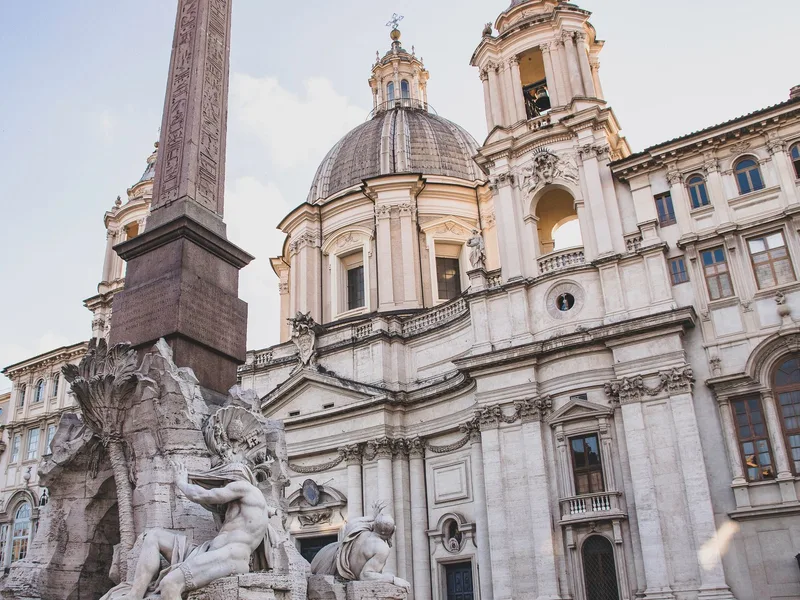
Piazza Navona, five minutes west, built on the footprint of Domitian's stadium — which is why it is that shape. Bernini's Four Rivers fountain is in the middle.
The Trevi Fountain, ten minutes east. Since February 2026 the lower basin costs €2 to enter between 9am and 10pm. The piazza and the view stay free at all hours, and the basin itself is free after 10pm — so if you're coming back through the centre tonight, that is both the cheaper and the better visit. Toss the coin with your right hand over your left shoulder.
The Spanish Steps, ten minutes north, to close the loop. You may sit on them; you may not eat or drink there, and the fine is real.
Afternoon: Choose One (15:00–18:00)
This is the flexible block, and the instruction is to pick one of these, not to attempt two.
Galleria Borghese — if you pre-booked. Bernini's Apollo and Daphne and The Rape of Proserpina do things with marble that should not be possible, and there are six Caravaggios. Timed two-hour slots, hard visitor cap, sells out weeks ahead. Non-negotiable to book.
Villa Borghese park — the low-effort alternative if you didn't book, and a genuinely good one. Bike or rowboat rental covers the tree-lined avenues and the lake without planning, and the Pincio terrace at the southern end looks out over Piazza del Popolo and the rooftops.
Trastevere early — cross the river and simply walk. Trastevere in the afternoon, before the evening crowd arrives, is at its best, and Santa Maria in Trastevere's twelfth-century gold mosaics are free and consistently overlooked.
The Aventine keyhole — fifteen minutes uphill from the Circus Maximus, where St Peter's dome sits framed at the end of a hedged avenue. The orange garden next door has one of the loveliest views in Rome and is almost never crowded.
Rest. Genuinely a valid option, and in July the correct one. Romans go home between two and four for a reason. Coming out again at five, refreshed, will get you more out of the evening than a fourth monument.
Evening: Trastevere (19:00 onward)
Cross the Tiber into Trastevere for dinner. Book ahead if you want Da Enzo al 29, or Roscioli in the centre beforehand; otherwise wander the back streets and pick somewhere busy with locals rather than tour groups. The tell is simple — look for Italian on the tables and no one outside holding a laminated menu.
If you'd rather eat better than atmospherically, Testaccio is twenty minutes away and is where Roman food actually comes from; you'll pay about half what you would within sight of a monument. See the restaurants guide.
Afterwards: an aperitivo or a late drink at Freni e Frizioni, a former mechanic's garage and the benchmark cocktail bar in the neighbourhood, then walk back across Ponte Sisto for the illuminated Tiber.
If you have anything left, this is the moment to go back to the Trevi after 10pm, when the fee lifts and the crowd is gone. Floodlit, half-empty, and free — it is a completely different fountain from the one you saw at two in the afternoon.
A guided night walk through the centro is a structured alternative if you'd rather have the evening narrated than improvised.
If You Only Have Half a Day
Cut the afternoon block entirely and compress:
- Morning half-day: Colosseum, Forum, Capitoline terrace. Lunch in Monti.
- Afternoon half-day: Pantheon, Navona, Trevi, Spanish Steps, on foot.
Either half stands on its own. Don't try to fit the Vatican into either.
Practical Notes for the Day
Wear proper shoes. You will cover 15km or more on uneven stone. This is the advice everyone ignores and regrets by three in the afternoon.
Refill your water. The nasoni street fountains run cold and free — there are around 2,500 of them. Buying bottled water in Rome is a self-inflicted expense.
Coffee standing at the bar costs about a third of coffee at a table. Both prices are legal and posted. On a one-day trip that difference adds up fast.
Watch your pockets at the Trevi, in the Colosseum queue, on Metro line A and on buses 40 and 64. A zipped bag worn across the front handles nearly all of it — see the safety guide.
Left luggage: if you're passing through on a layover, Termini and most major stations have paid storage, which is what makes a one-day Rome trip workable between trains.
Realistic Expectations
One day covers the essentials, not the city. You will see the outside of a great deal and the inside of very little, and that is the correct trade at this length — Rome punishes rushing more than most cities forgive it.
If you can stretch to two days, add the Vatican as its own morning. If you can stretch to three, add a neighbourhood — Monti or Testaccio — and slow down. Our three-day itinerary sets that out in full.