All Guides/culture
culture · 6 min read
The Pantheon: Tickets, Fees & What to See
The Pantheon is no longer free — entry is €5. How to book, when to go, how to get in free, and what to actually look at once you're under the dome.
By Todo Rome · Updated 2026-09-09
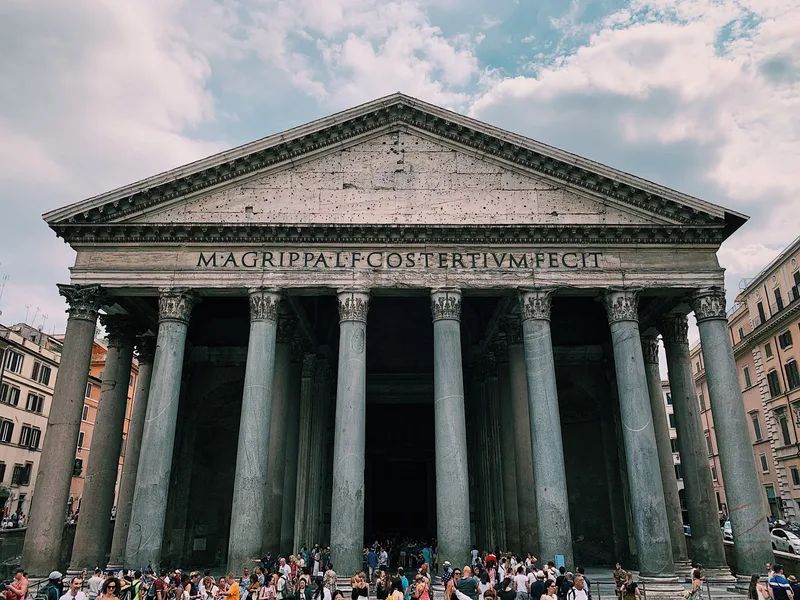
Yes, You Have to Pay Now
The Pantheon charged nothing for its entire modern history. Since July 2023 it costs €5, and this remains one of the most common surprises in Rome — partly because free entry was so long-established, and partly because it is a working church, which people reasonably associate with open doors.
The fee applies to general visitors. It does not apply to:
- Residents of Rome
- Under-18s
- EU citizens aged 18–25, who pay a reduced rate of around €2
- Anyone attending Mass (see below)
Tickets are sold online and at the door. Unlike the Colosseum or the Borghese, the Pantheon does not meaningfully sell out — the building absorbs a lot of people. Booking online mainly saves you standing in the queue on the piazza, which in July is worth €1 of anyone's money.
How to Get In Free
There is a legitimate route, and it is not a loophole so much as an acknowledgment that the building is still the Basilica of St Mary and the Martyrs.
Attending Mass is free. Services run on Saturday evenings and Sunday mornings, plus holy days. You enter as a worshipper, not a ticket-holder.
The obvious caveat: this is a religious service, not a workaround for sightseeing. You are expected to attend properly — sit, participate or at least stay respectfully quiet, and not wander the perimeter photographing the dome during the liturgy. If that isn't what you want, pay the €5.
There is also a genuinely free option that costs nothing and requires nothing: the portico. The sixteen granite columns out front are original, each a single piece of Egyptian stone shipped from Mons Claudianus, and standing under them gives you a real sense of the scale. You can see into the rotunda from the threshold. It isn't the same as being inside, but it isn't nothing.
When to Go
The Pantheon is open daily with shorter hours on Sundays and some holy days, and the crowd pattern is predictable:
- First thing in the morning is best. The queue is short and the light through the oculus is at its most dramatic on the western wall.
- Midday is worst — peak tour-group traffic, and the piazza outside is a scrum.
- Late afternoon thins out again.
- After dark the building is closed but floodlit, and Piazza della Rotonda at 11pm, with the fountain running and the portico lit, is one of the best free half-hours in Rome.
If it rains, go. Rain falling through the oculus into the middle of the rotunda, and draining away through the original Roman floor holes, is the single best thing the building does. Most people never see it because they avoid sightseeing in the wet. The floor is very slightly convex and drilled with drainage holes that have worked continuously for nineteen centuries.
What to Actually Look At
Most visitors walk in, photograph the dome, and leave in six minutes. A few things are worth slowing down for.
The oculus. Nine metres across, open to the sky, no glass, never had any. It is the building's only light source and it is structural — the dome is a compression ring, and the hole at the top is doing work, not just letting light in. Watch the disc of sunlight travel across the coffered ceiling and down the wall; on a clear day it moves visibly.
The dome itself. 43.3 metres across and 43.3 metres from floor to oculus, so a perfect sphere would sit exactly inside the space. It remains, nineteen centuries on, the largest unreinforced concrete dome in the world — nobody has built a bigger one without steel. The Romans graded the aggregate as they went, heavy travertine at the base, light volcanic pumice at the top, so the structure gets progressively lighter as it rises. The coffers aren't decoration either; they remove mass.
The floor. Largely original Roman marble, in the original pattern, with the original drains. You are walking on a second-century surface, which is rarer than the dome.
Raphael's tomb. He asked to be buried here and was, in 1520. The inscription is worth reading — it translates roughly as "here lies Raphael, by whom Nature feared to be outdone while he lived, and when he died, feared to die herself." Also here are two kings of unified Italy, Vittorio Emanuele II and Umberto I, which is why you will occasionally find a small honour guard.
What's not here. The bronze that once covered the portico ceiling was stripped in the seventeenth century by Pope Urban VIII, of the Barberini family, and reused — most likely for cannon at Castel Sant'Angelo. It produced the Roman line quod non fecerunt barbari, fecerunt Barberini: what the barbarians did not do, the Barberini did.
Practical Notes
Dress code applies. It is a church. Shoulders and knees covered; you can be turned away, and in summer people are, daily.
Bags and security. Airport-style checks at the entrance. Travel light and it takes two minutes.
Time needed. Twenty to thirty minutes inside is plenty unless you are an architecture obsessive, in which case an hour will vanish.
Accessibility. Step-free entry from the piazza and a flat interior — one of the more straightforward major sites in Rome for wheelchair users, which is not something you can say about the Forum.
Where to Eat Nearby
The piazza itself is a tourist-price zone. The rule holds: the closer your table is to a monument, the worse and dearer the food. Two exceptions within a short walk:
Armando al Pantheon sits essentially against the building and is genuinely good — a family-run Roman kitchen doing carbonara, coda alla vaccinara, and cacio e pepe properly. It is small, it books out well ahead, and it is the rare restaurant that survives its own location.
Otherwise, walk five minutes in any direction away from the rotunda before you consider sitting down. Toward Via dei Coronari or across to the Campo de' Fiori side, the prices drop and the cooking improves at roughly the same rate.
For coffee, stand at the bar — €1.20 rather than €4.50 seated, and the same espresso. Sant'Eustachio Il Caffè and Tazza d'Oro are both a minute away and both very good; the latter's granita di caffè con panna is the correct order in August.
Fitting It Into a Day
The Pantheon is small and central, and it should be a stop rather than a destination. It sits within ten minutes of the Trevi Fountain, Piazza Navona, and Campo de' Fiori, and the natural sequence is to string those together on foot in an afternoon or, better, an evening.
An evening route that costs almost nothing: Piazza Navona at dusk, the Pantheon portico floodlit at around 10pm, then the Trevi after 10pm when its €2 basin fee lifts. That is the centro at its best, and you'll have spent nothing but the price of a gelato.