All Guides/culture
culture · 3 min read
Piazza del Popolo: What to See & How to Get There
Rome's monumental northern gateway square, with an Egyptian obelisk, twin churches, and two Caravaggio paintings inside Santa Maria del Popolo. Free and always open.
By Todo Rome · Updated 2026-11-02
What Piazza del Popolo Is
Piazza del Popolo is the monumental square where Via del Babuino, Via di Ripetta and Via del Corso meet, forming the traditional northern entrance into Rome's historic centre. It is free to enter and always open, with no tickets involved.
The square takes the shape of a large ellipse around a central Egyptian obelisk, a layout designed by Giuseppe Valadier in the early nineteenth century.
When to Go
Any time. It is an open public square with no opening hours of its own. Early morning or early evening avoids the biggest crowds and gives better light for the obelisk and the twin churches.
Getting There
The nearest metro stop is Flaminio, on Line A, also served as Flaminio/Spagna.
The Obelisk
The column at the centre of the square is the Flaminio Obelisk, about 24 metres tall. It was moved here from the Circus Maximus in 1589, by order of Pope Sixtus V, and was the first Egyptian obelisk ever moved to Rome. It was originally erected under the emperor Augustus.
Porta del Popolo and the Twin Churches
Porta del Popolo, the gate at the square's northern end, has two faces with two different histories. Its outer façade, facing away from the city, was commissioned by Pope Pius IV from Michelangelo and completed by Nanni di Baccio Bigio between 1562 and 1565. The inner façade, facing into the square, was added later by Bernini for Pope Alexander VII. It carries an inscription marking Queen Christina of Sweden's arrival into Rome through this gate in 1655.
At the opposite end of the square stand the so-called twin churches, Santa Maria in Montesanto and Santa Maria dei Miracoli. They were designed by Carlo Rainaldi and completed by Bernini with Carlo Fontana. The two domes are not actually identical, but an optical effect makes them look it from the square itself.
Santa Maria del Popolo
Santa Maria del Popolo, on the square's north-eastern side, grew from a chapel founded by Pope Pasquale II and funded by the people of Rome, which gives the church its name. It was rebuilt and enlarged in Renaissance style between 1472 and 1477.
Inside, the Cerasi Chapel holds two paintings by Caravaggio, the Crucifixion of St. Peter and the Conversion of St. Paul, both from around 1601 and commissioned by Tiberio Cerasi, treasurer to Pope Clement VIII. The altarpiece between them, an Assumption of the Virgin, is by Annibale Carracci.
The Chigi Chapel was designed by Raphael from 1513 for the banker Agostino Chigi and completed by Bernini between 1652 and 1656. The Della Rovere Chapel, built earlier by Andrea Bregno, has frescoes attributed to Pinturicchio's workshop.
The church does not publish general opening hours; for mass times and visiting conditions, it directs visitors to contact the parish directly.
The Pincio Terrace
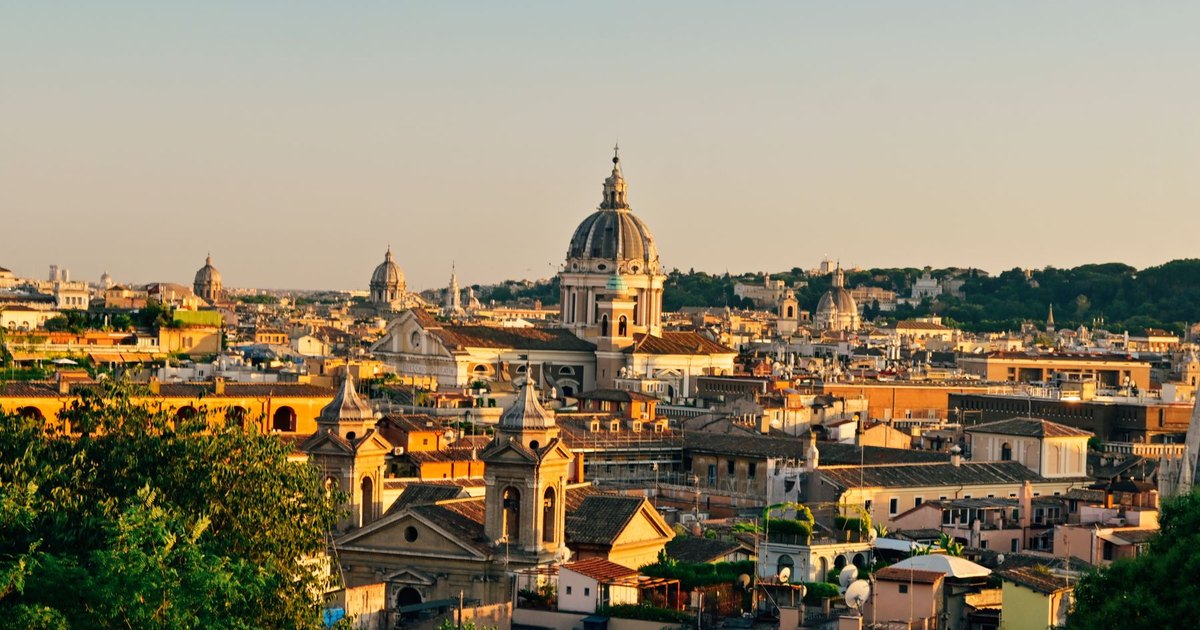
Behind the square's eastern side, where the Dea Roma fountain stands, a path leads up to the Pincio terrace at the edge of Villa Borghese. It is a good spot for a sunset view back over the square and the rooftops beyond.
FAQ
Is Piazza del Popolo free to visit? Yes. It is a public square with no entry fee and no fixed hours.
What metro stop is closest to Piazza del Popolo? Flaminio, on Line A.
What is the obelisk in the middle of the square? The Flaminio Obelisk, moved here from the Circus Maximus in 1589 on the order of Pope Sixtus V.
Can I see the Caravaggio paintings for free? The paintings are inside Santa Maria del Popolo, which does not charge an entry fee, but the church sets its own hours for visiting versus mass times.
Nearby
For more free sights across the city, see our guide to free things to do in Rome. The square sits at the edge of Centro Storico, and it features in our one-day Rome itinerary.