All Guides/culture
culture · 4 min read
Rome After Dark: Three Self-Guided Evening Walks
Rome's monuments are floodlit, free to walk past and emptiest after 9pm. Three routes through the lit city — what to see, in order, and how long each takes.
By Todo Rome · Updated 2026-09-21
Why Rome Is Better at Night
The case is simple and it's mostly about crowds. The day-trip coaches leave in the late afternoon, the queues dissolve, and by nine in the evening the same piazzas that were impassable at noon have a few dozen people in them. The monuments stay floodlit. In summer, the heat that made walking miserable at three o'clock is gone. And the whole thing — every route below — costs nothing, because you are walking on public streets looking at buildings from the outside.
This isn't a substitute for going inside the Colosseum or the Pantheon. It's the other half of the city, and most visitors never see it because they've structured their trip around opening hours.
Route One: The Centro Storico Classic
Roughly 40 minutes of walking. Best from 9pm.
Start at Piazza Navona. Bernini's Fountain of the Four Rivers is lit from below at night and the square empties enough that you can actually stand back and look at it. The cafés around the edge charge for the privilege of sitting — see the note on seated prices in our tourist-trap guide — but walking through is free.
Cut east through the lanes to the Pantheon, five minutes away. It's closed in the evening, and it doesn't matter: the portico is lit, the square in front of it is one of the best places in Rome to stand at eleven at night, and you get the scale of the thing without a queue in front of it.
From there north-east to the Trevi Fountain, about eight minutes through the narrow streets. Trevi at night is the single biggest improvement over Trevi by day — the lighting is designed for it, and the crowd, while never absent, is a fraction of the afternoon crush.
Finish at the Spanish Steps, another ten minutes north. Remember that sitting on the steps is banned and fined; the view from the bottom of the Barcaccia fountain with the twin towers above is the point anyway.
Route Two: Ancient Rome, Floodlit
Roughly 30 minutes. Best from dusk onwards.
This is the one most people don't know is possible, because they assume the Forum being closed means there's nothing to see.
Start by climbing the Cordonata, Michelangelo's ramped staircase up to the Capitoline. At the top, cross Piazza del Campidoglio and walk around either side of the Palazzo Senatorio to the terrace at the back. From there you are looking straight down over the Roman Forum, floodlit, with the Colosseum beyond it. It's free, it's open air, it's accessible in the evening, and it is one of the great views in Europe.
Come back down and walk south-east along Via dei Fori Imperiali. The Imperial Forums run along both sides of the road and are lit and visible from the pavement the entire way — Trajan's Column, the Forum of Augustus, the markets.
The road delivers you to the Colosseum, about fifteen minutes from the Capitoline. Lit, enormous, and at ten at night surrounded by a fraction of the daytime crowd.
Route Three: Trastevere and the Gianicolo
Roughly 45 minutes with the climb. Best just before sunset if you want the view in daylight, or after dark for the lights.
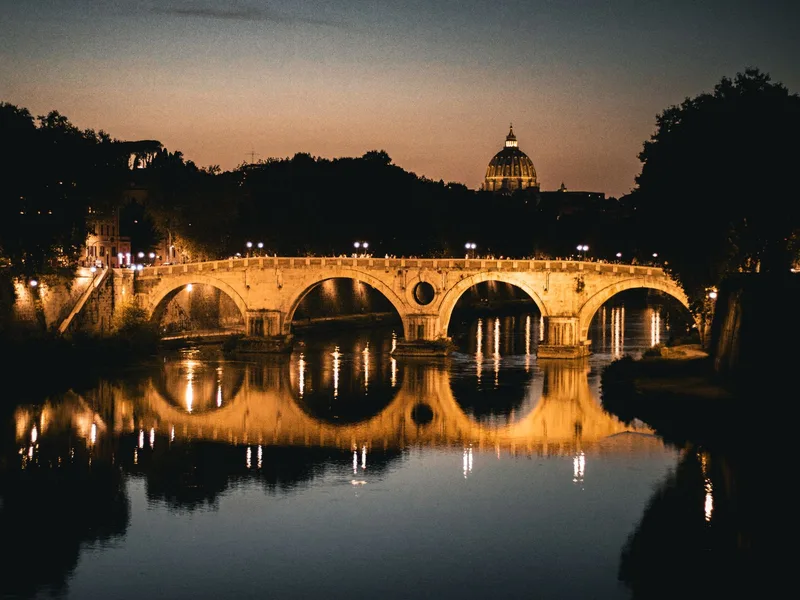
Cross the river on Ponte Sisto, a pedestrian bridge, into Trastevere. Work your way through the lanes to Piazza Santa Maria in Trastevere, where the basilica's medieval façade mosaics are lit at night and the square functions as the neighbourhood's living room.
Then the climb: up to the Gianicolo (the Janiculum), the ridge above Trastevere. It's a genuine uphill walk of fifteen to twenty minutes, and the payoff is the terrace at Piazzale Garibaldi with the entire city laid out below — domes, the Vittoriano, the whole skyline. Free, open, and busiest at sunset.
Coming back down puts you in the middle of Trastevere's restaurant streets at exactly the right time for dinner.
Practical Notes
Footwear. All three routes are on sampietrini, the cobblestones — see our guide to Rome's cobblestones for what that means in practice. Flat, grippy shoes; the stones are polished and get slick in rain.
Water. The nasoni run all night. You don't need to buy bottled water on any of these walks.
Safety. Central Rome is comfortable to walk in the evening and these routes stay on busy, lit streets throughout. The pickpocketing risk is the same as by day and concentrates in the same stationary crowds — our safety guide has the specifics.
Timing. Floodlighting is generally on from dusk. The crowds thin noticeably after about nine and again after eleven.
Is a Guided Night Tour Worth It?
Honestly: only if you want the history narrated. Every route above is public street, permanently open, and needs no ticket or booking — there is nothing a guide unlocks that you can't walk to yourself. What a guide adds is context, and for some people that's worth paying for, particularly on the ancient Rome route where what you're looking at is ruins that need explaining. If that's you, our evening walking tour covers the ground with someone doing the talking. If it isn't, take this page and go.